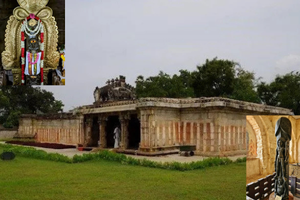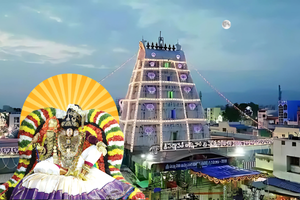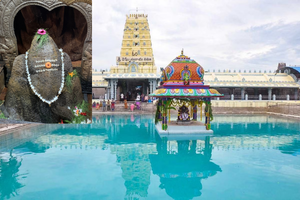
Sri Kalahasti, sometimes called Kalahasti, is an important temple city in Andhra Pradesh in the Chittoor district of India. It is called Sri Kalahasteeswara Temple, an important temple of Hindus and is dedicated to Lord Shiva. The shrine is one of many in South India that has a legendary background and is significant in spiritual significance.
Detailed Historical and Mythological Context:
Mythological Legend:
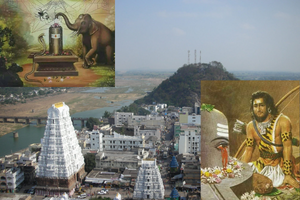
 The Story of the Spider, Serpent, and Elephant: The architecture tells the story of a spider (Sri), a serpent (Kala), and an elephant (Hasti), who were devotees who were worshipped at the shiva linga here. The spider made a web around the Linga and rolled a ball of silk away from it to shield it from wind; the serpent wrapped jems around the Linga; and the elephant splashed water on it from the nearby river (Swarnamukhi). Determined by their worshiping, Lord Shiva gifted salvation and perpetual residence in the form of the town known as Sri Kalahasti.
Kannappa Nayanar: The second references are connected with Sri Kalahasti and involve many legends of the 63 Nayanars, of which Kannappa is well known. Kannappa, once a tribal hunter who saw blood at Linga, offended the deity, and when he realised his folly, offered his own eyes to the lord. This acts and commitment so passionate agitated Lord Shiva, who blessed him with his eyesight along with Moksha (liberation).
Historical Timeline:
Pallava and Chola Dynasties: The history of the temple starts from the early permanent structure building Pallava dynasty (4th century to 9th centuries AD). The Chola dynasty (9th to 13th century AD) of South India built more on the temple complex, and there are many records and inscriptions of the Chola period mentioning how much donation has been made to the temple in the form of land, crops, etc.
Vijayanagara Empire: The temple gained prominence during the rule of the Vijayanagara dynasty, especially during the reign of Krishnadevaraya in the 16th century. This is the Vijayanagara emperor, and used to have constructed the entry gopuram, or large decorative towers, and donated them to the temple and turned the temple into the supreme idol.
Architectural Features:
Gopuram and Vimana: The temple’s high, rising Gopuram is undoubtedly the tallest, with a height of 120 feet, and thus architectural define the skyline of the temple town. This is also accompanied by the Vimana part above the sanctum, where a lot of carvings are provided and it represents various gods and goddesses along with different mythological scenes.
Inner Sanctum: The deity of worship in the main sanctum is the Linga, which is said to be self-created and is known as Kalahasteeswara. The sanctum is designed in a way that even a gentle breeze signify the Vayu element where air is felt.
100 Pillared Hall: It also contains a 100-pillared hall that was built during the Vijayanagar Empire and also depicts the archaeological brilliance of that age. The hall has detailed carvings as well as brilliant sculptures representing scenes from Hindu mythology.
Cultural and Religious Practices:
Rahu Ketu Pooja: Another interesting feature of the temple that stands out is the Rahu Ketu Pooja, an offering to Rahu and Ketu, celestial bodies, that people pay obeisance to get free of the vices the astrological influences cause. This pooja is believed to be most effectively done in this temple, and thousands of devotees come to this temple daily.
Festivals: There are several others that are mainly observed, of which the Maha Shivaratri festival is known for its fully dressed-up procession, special darshan, and of course, rush of devotees. Another festival celebrated annually is the Brahmotsavam, during which the deity is taken on procession, seated in a chariot.
Cultural Contributions:
Kalamkari Art: The colour Kalamkari is also worth mentioning. style of Kalamkari work, which involves dyed hand-painting of a fabric. Sri Kalahasti. But those works have to illustrate scenes from Hindu epics and the temple structure, making it one of the most exportable products of the region.
Modern Era and Tourism:
The town of Sri Kalahasti has emerged into a significant pilgrimage spot as well as a tourist’s hot spot in the present generation. Accessibility is well corroborated by the fact that it is near Tirupati, which is also another important pilgrimage destination. Temple Town also remains a hub for Kalamkari art form, which is still practiced, with some of the artifacts getting international markets.
Due to these two attributes, Sri Kalahasti has the potential to become one of the most distinguished localities in the context both of the religious and cultural geography of South India.